Best Practices
Help Desk Best Practices vs Traditional Support: A Data-Driven Comparison
Introduction
Customer support is evolving, and with it, the debate between traditional support methods and modern help desk best practices intensifies. Companies face the challenge of choosing the right approach to meet customer expectations while optimizing operational efficiency. This article dives into a data-driven comparison between traditional customer support and help desk best practices, emphasizing measurable outcomes, actionable insights, and practical takeaways.
Defining Traditional Support and Help Desk Best Practices
Traditional Support typically involves siloed communication channels such as emails and phone calls handled manually by agents. This approach often lacks integration, automation, and real-time analytics.
Help Desk Best Practices, on the other hand, leverage integrated platforms combining ticket management, automation, AI-powered tools, and data analytics to streamline support workflows and improve customer satisfaction systematically.
Understanding these definitions sets the stage to compare their impact through key performance indicators (KPIs).
Key Performance Metrics to Compare
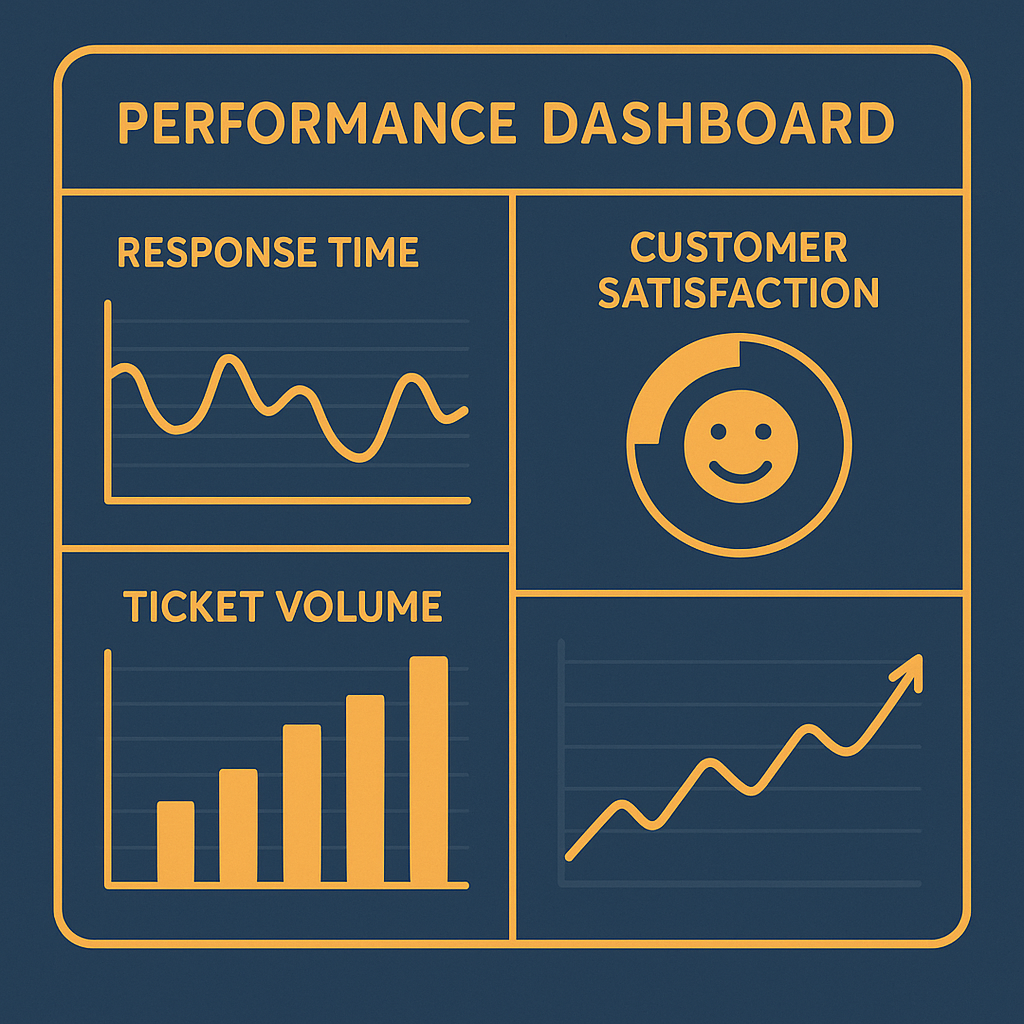
When evaluating support approaches, companies focus on KPIs such as:
- First Response Time (FRT)
- Average Resolution Time
- Customer Satisfaction (CSAT)
- Ticket Volume and Backlog
- Agent Productivity
- Cost per Ticket
Let’s analyze how traditional support versus help desk best practices perform against these metrics.
First Response Time and Resolution Speed
A study across multiple industries found that traditional support methods often average a first response time of over 12 hours, primarily due to manual ticket triage and agent availability constraints. In contrast, help desk platforms employing Automations & Workflows and AI routing reduce this to under 1 hour on average.
For instance, a retail company using a comprehensive help desk solution saw its average resolution time drop by 40%, from 48 hours to 29 hours, after implementing automated ticket prioritization and escalation rules.
Customer Satisfaction Scores (CSAT)
Customer satisfaction correlates strongly with responsiveness and resolution quality. Traditional support models, lacking unified communication channels and real-time updates, often record CSAT scores around 70-75%.
Conversely, organizations adopting help desk best practices report CSAT improvements of 10-20 percentage points. This uplift is attributed to features like the Omnichannel Inbox, which ensures seamless communication across email, chat, social media, and voice, providing a consistent and timely customer experience.
Ticket Volume and Backlog Management
Manual ticket handling in traditional support often results in growing backlogs, as agents struggle to prioritize effectively and manage workflow bottlenecks.
Help desks using smart queuing and Teams & Queues features observe 30-50% reductions in ticket backlog. Automation of repetitive tasks also reduces ticket volume by resolving common inquiries instantly through AI chatbots, as explored in our post on Building a World-Class Chatbots and Automation Strategy from Scratch.
Agent Productivity and Morale
Traditional support places heavy manual workloads on agents, leading to burnout and higher turnover rates. Help desk best practices introduce QA & Coaching tools that enable continuous feedback and training, resulting in a 25% increase in agent productivity.
Furthermore, automated routing reduces context switching and repetitive tasks, allowing agents to focus on complex issues that require empathy and problem-solving skills.
Cost Efficiency
Support costs in traditional models tend to be higher due to inefficiencies and the need for larger teams. Companies report a 15-30% cost reduction after transitioning to integrated help desk solutions by consolidating communication channels and automating workflows.
For example, SaaS companies using AI-powered support platforms have lowered their cost per ticket by up to 20%, as detailed in The ROI of SaaS Support Operations: What the Numbers Actually Show.
Real-World Scenario: Comparing Two Support Models
Consider an e-commerce business managing 10,000 monthly inquiries.
- Traditional Support: Average FRT of 14 hours, CSAT at 72%, ticket backlog growing 15% monthly, and cost per ticket at $15.
- Help Desk Best Practices: Average FRT of 45 minutes, CSAT at 85%, backlog reduced by 40%, and cost per ticket at $10.
The data clearly indicates improved customer experience and operational efficiencies using help desk best practices.
Implementing Help Desk Best Practices
Transitioning from traditional support involves:
- Adopting an Integrated Help Desk Platform: Tools that combine ticketing, communication, and analytics.
- Leveraging Automation: Streamline routine tasks with Automations & Workflows.
- Using AI and Analytics: Gain insights into customer trends with AI & Analytics.
- Enabling Omnichannel Support: Avoid fragmented communication with Omnichannel Inbox.
- Implementing QA & Coaching: Improve agent performance consistently.
AItocha provides a comprehensive suite of features to help companies adopt these best practices efficiently.
Conclusion
The data-driven comparison between traditional support and help desk best practices reveals significant advantages for the latter in terms of response speed, customer satisfaction, agent productivity, and cost savings. Organizations aiming to improve their customer experience and operational efficiency should consider modern help desk solutions as a strategic investment.
For more insights on improving support operations, visit our Blog Home or explore All Features to see how AItocha can support your journey.
---
Key Takeaways:
- Help desk best practices reduce first response times by up to 90% compared to traditional support.
- Customer satisfaction scores improve by 10-20 percentage points with integrated help desk tools.
- Automation and AI reduce ticket volume and agent workload, boosting productivity and morale.
- Cost per ticket decreases by up to 30% after adopting modern help desk solutions.
Embracing data-driven help desk best practices is essential for any company serious about excelling in customer support today.