AI & Automation
What Customers Actually Want from Chatbots and Automation in 2026
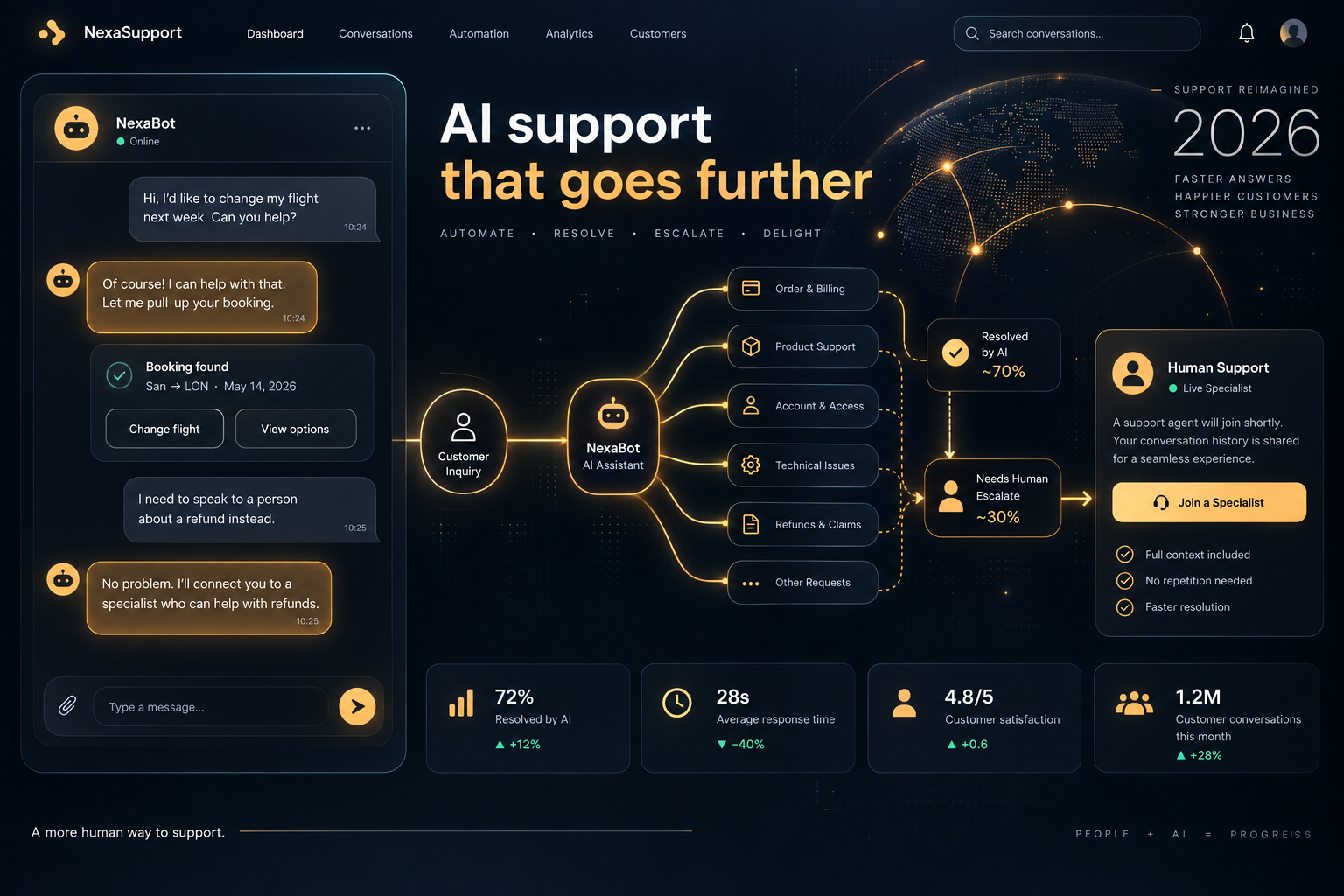
The biggest mistake teams still make with chatbots
A lot of support teams still build automation as if the goal is to deflect every possible ticket. That’s not what customers want. In 2026, most people are fine with chatbots and automation if those tools save time, solve a real problem, and don’t trap them in a loop.
The difference matters. A bot that answers a password-reset question in 20 seconds feels helpful. A bot that asks for the same order number three times and still can’t route the case to the right agent feels like a dead end. Customers usually don’t hate automation itself; they hate bad automation.
That’s why the real question is not “How do we add more bots?” It’s “What do customers actually expect automation to do?”
What customers want most: speed without friction
If you strip away the hype, customer expectations are pretty simple:
- Get an answer quickly
- Avoid repeating themselves
- Reach the right channel without extra steps
- Escalate to a human when the issue is complex
- Keep context across every interaction
Speed is the biggest reason people accept chatbots. In many support journeys, customers are willing to self-serve for common questions like shipping status, billing updates, password resets, appointment changes, and basic product how-tos. They just don’t want the bot to behave like a maze.
This is where chatbots and automation should be designed around task completion, not conversation for its own sake. A customer asking “Where is my order?” does not need a friendly 12-message exchange. They need the order status.
The new standard: automation should be useful, not clever
Customers have become less impressed by bots that try to sound human and more impressed by bots that are accurate.
In practice, that means automation should do four things well:
- Recognize intent fast
- Ask only for missing information
- Resolve common issues end-to-end
- Escalate cleanly
That last point is where many support teams lose trust. A customer may tolerate a bot for a refund request, but if the issue becomes a charge dispute or a failed delivery, they want a human fast. Good automation knows when to step aside.
Customers want context preserved across channels
One of the most frustrating support experiences is having to restart the conversation every time you switch channels. A customer starts in chat, gets referred to email, then has to explain the issue again to a phone agent. That’s not efficient, and it’s not what customers expect anymore.
In 2026, customers increasingly assume that support systems can share context across channels. If they already typed their order number into chat, that data should follow them into the next step. If they already described the issue, the agent should see it immediately.
This is where an omnichannel inbox becomes more than a convenience feature. It keeps the conversation intact so customers don’t have to repeat themselves, and it helps teams reduce unnecessary back-and-forth.
They want self-service for simple tasks, not for everything
A common misunderstanding is that customers want to self-serve every problem. They don’t.
They are usually happy to use automation for:
- Checking delivery or appointment status
- Resetting passwords
- Updating account details
- Finding product instructions
- Confirming billing dates
- Reordering common items
But they still prefer human help for:
- Refund disputes
- Technical issues with multiple causes
- Account access problems with security implications
- High-value purchases
- Emotional or urgent situations
The best support teams draw that line clearly. They use automation for high-frequency, low-complexity tasks and reserve human agents for nuanced cases.
If you need a deeper framework for deciding where automation fits, AItocha’s Automations & Workflows can help teams route, prioritize, and escalate issues based on real customer behavior instead of guesswork.
Personalization matters more than personality
A lot of teams still overinvest in making bots sound casual, witty, or “human.” Customers care much more about whether the bot knows who they are and what they need.
For example, a returning customer who has already placed an order should not be asked to re-enter their email address and shipping details if the system can retrieve them automatically. A support bot that says, “I found your order from Tuesday and your delivery is delayed by one day,” feels far more valuable than one that starts with a joke.
That’s because personalization reduces effort. The best automation feels like it was built around the customer’s actual situation, not a generic script.
Customers still want a clear path to a human
The most successful chatbots in 2026 are not the ones that try to replace support teams. They are the ones that know when to hand off.
Customers want three things from escalation:
- A visible option to reach a person
- No need to repeat the full story
- A realistic wait time or next step
If the system can’t solve the issue, it should say so plainly. Hidden escape hatches and repeated “Did that solve your problem?” prompts erode trust quickly.
That’s why support leaders should treat escalation as part of the design, not a failure state. Good escalation is a feature.
What support teams should measure instead of just deflection
If you only measure how many tickets a bot deflects, you’ll optimize for the wrong outcome. Customers care about resolution quality, not just containment.
Better metrics include:
- First-contact resolution rate
- Time to resolution
- Escalation accuracy
- Customer satisfaction after bot interactions
- Percentage of issues resolved without repetition
- Agent takeover rate for complex cases
This is where AI & Analytics becomes useful. Teams can see which intents automation handles well, where customers drop off, and which flows create unnecessary friction.
For a broader view of measurement, the article on measuring success with conversational AI is a helpful companion piece.
A practical formula for better automation in 2026
If you’re redesigning your bot strategy, start here:
- Map the top 20 customer intents
- Separate simple from complex issues
- Use real support transcripts
- Make escalation visible
- Test the handoff
- Review performance weekly
- Improve with feedback
The goal is not to create an AI that behaves like a person. The goal is to create support that feels efficient, respectful, and accurate.
Conclusion: customers want help, not a performance
In 2026, customers are not asking for more conversational fluff. They want automation that saves time, uses context, solves common issues, and hands off smoothly when needed. The best chatbot experience is the one that feels almost invisible because it gets the job done.
If your support automation is built around real customer intent—not just ticket reduction—you’ll give people exactly what they want: faster answers, less repetition, and a clear path to resolution.