Best Practices
5 Practical Ways to Reduce Ticket Volume with Omnichannel Support
Why ticket volume keeps growing even when your team works harder
Most support teams don’t have a ticket problem — they have a channel problem. A customer starts on email, follows up on chat, then calls because nobody sees the full history. The result is duplicate tickets, longer resolution times, and agents answering the same question three times.
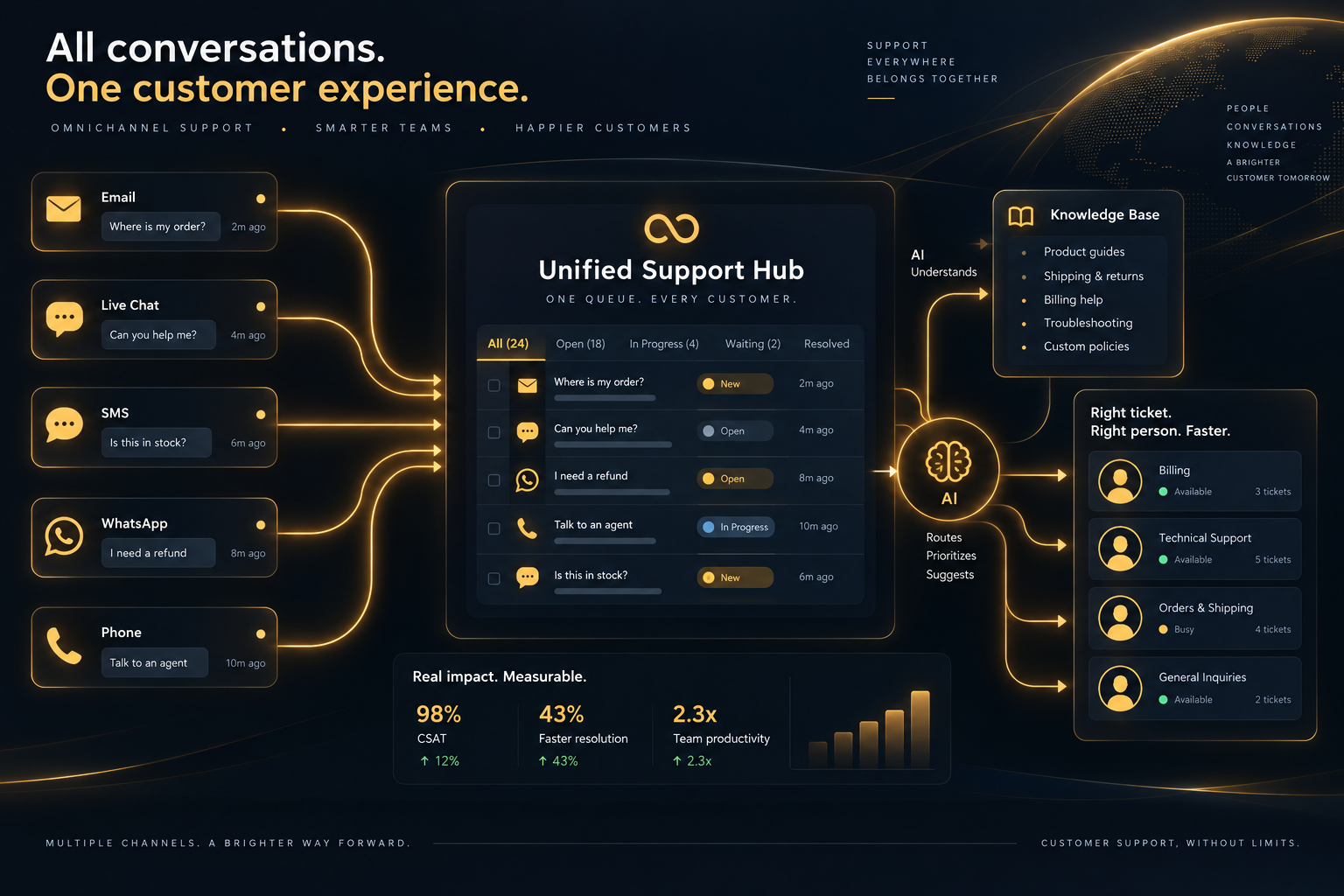
Omnichannel support reduces that noise by centralizing conversations and making it easier to solve issues on the first try. When your team can see every interaction in one place, you stop losing context and start preventing repeat contacts. If you’re building that foundation, a unified Omnichannel Inbox is the best place to start.
1. Put every customer message into one queue
The fastest way to reduce ticket volume is to stop creating separate workstreams for every channel. If email, chat, WhatsApp, SMS, and voice all land in different tools, customers often send the same request more than once because they don’t know whether anyone saw it.
A single inbox gives agents visibility into the full conversation history. That means they can answer, “Yes, we received your request,” without opening a second ticket. It also helps teams spot patterns like:
- Customers emailing, then messaging again after 10 minutes
- High-value accounts using one channel for the initial request and another for escalation
- Repeated questions coming from the same issue, not new problems
A support team handling 2,000 tickets a month can often eliminate dozens of duplicates simply by unifying intake. That’s time saved before any automation is added.
2. Deflect repetitive questions with a searchable knowledge base
A surprising share of tickets are not support problems at all — they’re “where do I find this?” questions. Password resets, billing dates, setup steps, return policies, and feature explanations are the usual suspects.
Publishing answers in a clear, searchable Knowledge Base reduces these tickets because customers can solve simple issues on their own before reaching an agent. The key is not just having articles, but making them easy to find and tied to the questions customers actually ask.
A practical approach:
- Export your last 30 days of tickets.
- Group the top 20 repeated questions.
- Turn each one into a short article with steps, screenshots, and a clear outcome.
- Link those articles inside chat, email signatures, and help widgets.
- Review article performance monthly and update anything with low views but high ticket impact.
If your team gets 500 “how do I change my plan?” tickets a month and 35% of those are deflected by better self-service, that’s 175 tickets removed without hiring anyone new.
3. Use automation to route and resolve simple requests instantly
Many teams try to reduce ticket volume by asking agents to work faster. That helps a little, but it doesn’t address the real issue: some tickets shouldn’t need an agent at all.
With Automations & Workflows, you can handle predictable requests automatically. Examples include:
- Sending order status updates when a shipment changes
- Auto-tagging billing, technical, and cancellation requests
- Collecting missing details before a ticket reaches an agent
- Triggering password reset instructions for common account issues
- Escalating urgent messages based on keywords or customer tier
This reduces ticket volume in two ways. First, some requests are fully resolved without human intervention. Second, the tickets that do reach agents arrive with better context, so they’re less likely to bounce back and forth.
A good rule: automate the work that follows a clear decision tree. If the same steps happen every time, your team should not be doing them manually.
4. Catch issues before they become repeat contacts
Customers usually reopen or resend tickets when they feel ignored or uncertain. If they don’t know whether support is working on the issue, they’ll send another message “just checking.” That creates extra volume even though the original problem is already in motion.
Reducing this kind of repeat contact requires better visibility into service levels and queue health. Tools like SLA Compliance and Teams & Queues help managers spot bottlenecks before customers feel the delay.
Here’s what to watch:
- Tickets approaching SLA breach
- Channels with rising reopen rates
- Agents overloaded with one issue type
- Customers waiting longer than your promised response window
For example, if billing tickets average a 26-hour first response while your SLA is 8 hours, customers will almost certainly follow up. Fixing that bottleneck can reduce repeat messages faster than any new macro or canned response.
5. Replace channel hopping with proactive communication
A lot of support volume comes from uncertainty, not complexity. Customers ask for updates because they don’t trust that they’ll get one.
Proactive communication reduces that pressure. When customers receive a clear status update, they’re less likely to call, email, and chat the same question across multiple channels. This is especially useful for outages, delivery delays, account reviews, and onboarding steps.
Use the channel that fits the urgency:
- Email for non-urgent updates
- SMS for time-sensitive notifications
- WhatsApp or voice for high-intent, high-urgency conversations
If you support customers across multiple touchpoints, pairing WhatsApp & Voice with SMS Messaging can reduce “any update?” tickets by keeping customers informed before they ask.
One ecommerce team, for example, can cut delivery-status tickets by sending automated shipment updates at three moments: order confirmed, shipped, and delayed. That alone can remove a meaningful chunk of “Where is my order?” contacts.
The real goal: fewer contacts, not fewer conversations
Reducing ticket volume does not mean hiding from customers. It means giving them better paths to self-serve, receive updates, and reach the right agent the first time.
The most effective omnichannel teams do five things consistently:
- Centralize every channel in one inbox
- Publish answers to repetitive questions
- Automate routine workflows
- Monitor queue health and SLA risk
- Communicate proactively before customers chase support
If you want to see how these pieces fit together in a broader service model, the Customer Service Solution page is a useful starting point.
Key takeaways
Ticket volume usually grows because of fragmented channels, repeat questions, and poor visibility — not because customers suddenly need more help. Omnichannel support lowers that load by making it easier to deflect, route, and resolve issues before they multiply.
Start with one queue, one knowledge base, and one automated workflow. Then measure what changes: duplicate tickets, reopen rates, first response time, and repeat contacts by channel. Those numbers will tell you where the next reduction opportunity is hiding.